A scan report mentioning a disc bulge, herniation or prolapse can raise many questions. What does it mean? Why does pain travel into a leg? Could a non-surgical approach help? Royal Multi Care offers spine assessment and advanced spinal decompression consultations through our Chennai and Coimbatore centres.
Disc bulge, herniation and prolapse
Discs sit between the bones of the spine. A bulge describes a broader extension of a disc beyond its usual boundary. Herniation describes a more localised displacement of disc material; “prolapse” and “slipped disc” are commonly used terms that may refer to a herniation.
A disc problem can irritate a nearby nerve and contribute to pain, tingling or weakness. But a scan finding does not, by itself, identify the cause of every symptom. Your examination and the pattern of your symptoms matter alongside the report.
How non-surgical decompression works
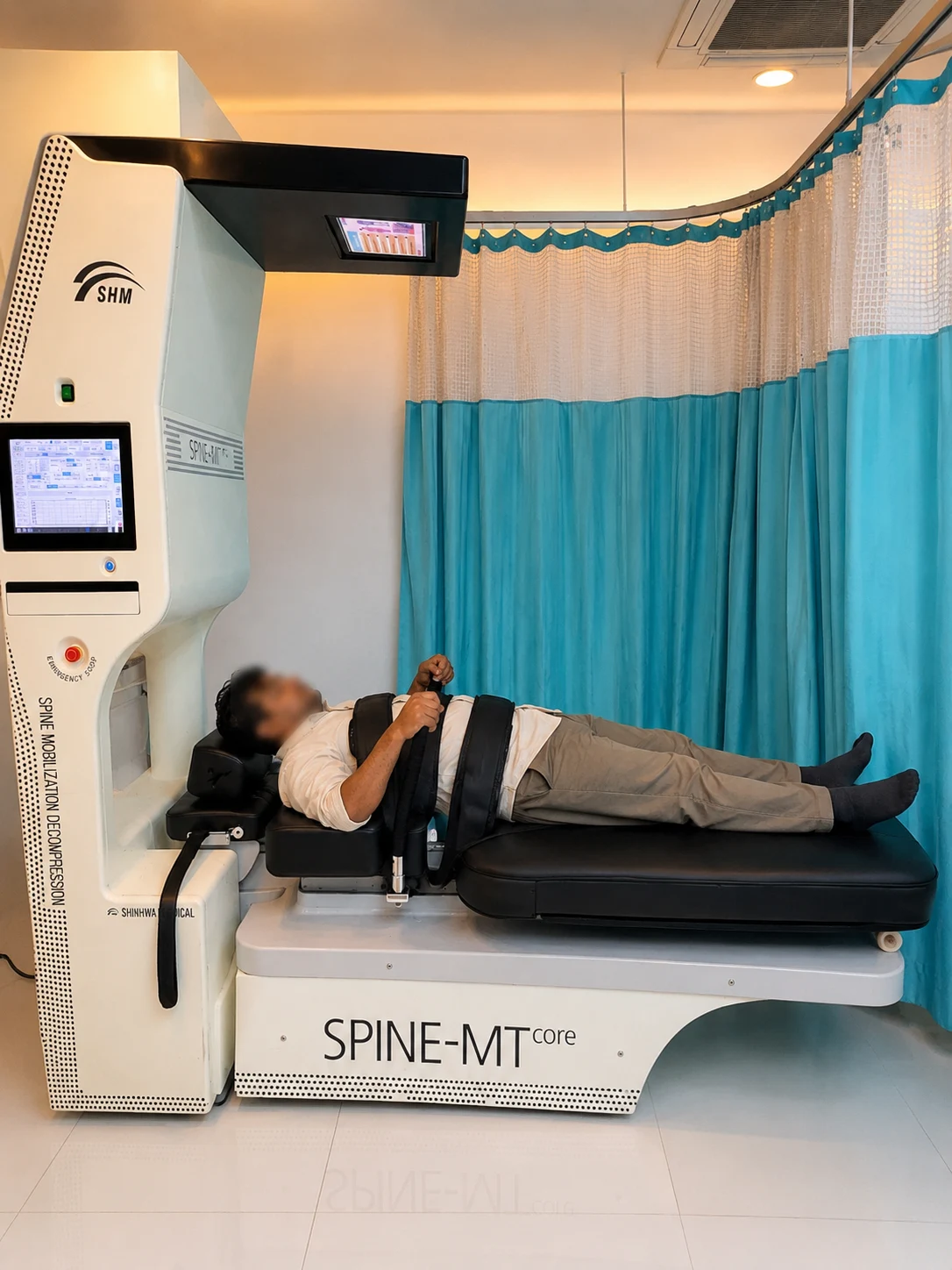
The clinic’s decompression system uses a treatment table and supporting harnesses to apply controlled pulling forces, with periods of relaxation. This is a form of mechanical traction. The intended effect is to temporarily change loading across the spine and reduce mechanical stress during treatment.
Your clinician sets the position and treatment parameters and monitors your response. This machine-based treatment is different from surgical decompression, which involves an operation to relieve pressure on nerves.
What benefit can reasonably be expected?
Some people report symptom relief after traction-based treatment, but evidence is mixed. It has not been established that a decompression machine reliably reverses a herniated disc, puts every bulge “back in place” or prevents surgery. NICE guidance does not recommend traction for routine management of low back pain with or without sciatica.
That distinction matters when discussing an advanced treatment: the proposed mechanism is not a guarantee of clinical benefit. Ask the clinician why it is being considered in your case, what alternatives exist and what would lead to changing the plan.
A complete spine-care plan
Your assessment should consider pain, nerve symptoms, strength, daily activity, health history and existing reports. A plan may include education, graded exercise, rehabilitation and medical review where needed. Session frequency and progress checks should be based on the clinical assessment rather than a standard package for every disc finding.
New difficulty passing urine, loss of bladder or bowel control, numbness around the genitals or bottom, or rapidly worsening leg weakness with back pain needs urgent medical assessment. Do not wait for a routine treatment appointment.
Book a spine consultation
Contact Royal Multi Care in Mogappair, Tambaram or Coimbatore. Bring existing scan reports if you have them. Our team will confirm the branch offering the equipment and arrange an assessment of your symptoms and treatment options.
Explore spinal decompression · Request a spine consultation
Further reading
NHS: slipped disc · NICE: low back pain and sciatica recommendations
For advice about your individual health needs, speak with your clinician.
Arrange a consultation ↗